


How much is a truck accident case worth in Denver?The value of a truck accident case in Denver depends on factors such as medical expenses, lost income, property damage, and each party’s share of fault under Colorado’s modified comparative negligence rule. An experienced personal injury attorney can investigate the crash, identify all liable parties, and help determine the compensation you may be able to recover. If you are found to be 50% or more at fault, you may be barred from receiving compensation under Colorado law. |
Being hit by an 80,000-pound semi can leave you badly hurt and shaken, and it is hard to feel like an equal when you are up against a trucking company, its insurer, and the investigators they send out the same day. You should not have to take that on by yourself. A personal injury lawyer can go toe-to-toe with the company and its defense team while you focus on healing.
- 20+ years of experience: At Levine Law, founder Jordan S. Levine and our Denver injury attorneys have helped injured people across the Denver metro for more than 20 years. Learn about our firm and the team who would handle your case.
- Proven results: The firm has won multi-million-dollar case results and verdicts for injured clients, and our client reviews show the care behind that work.
- Every Kind of Crash Case: Levine Law takes on every kind of crash case — from truck accidents to serious-injury and wrongful-death claims.
- Dedicated Legal Team: Your case is handled directly by our Denver injury attorneys and support staff, so you always know who is working on your claim.
- Contingency Fee Basis Available: You pay nothing upfront and owe no attorney’s fee unless we win. Our fee is just a percentage of what we recover for you — our “No Win, No Fee” promise. Contact our Denver office or call 303-333-8000 for a free consultation, and see the awards and recognition our attorneys have earned.
Colorado usually gives you three years to file a truck crash claim under C.R.S. § 13-80-101. For claims filed in 2025 or later, the cap on pain-and-suffering damages rose to $1.5 million — and truck evidence like the “black box” can vanish much sooner, so acting early protects your claim.
What should you do immediately after a truck accident in Denver?
Call 911 first. Get emergency medical care. Then write down who the truck, the driver, and the company are before you leave. In Denver, a Denver Police Department officer answers most crashes. On the interstates, Colorado State Patrol responds.
The first hour of a truck case shapes everything that follows. Here is how to protect your claim:
- Report the crash. C.R.S. § 42-4-1606 requires a prompt report of any crash with injury, death, or property damage. The police officer fills out a Colorado Traffic Crash Report (DR 3447). You can request a copy from the DPD Records Unit.
- Get checked at a trauma center — even if you feel fine. Truck-crash injuries are often internal and show up late. Denver Health Medical Center is the only Level I trauma center in the City of Denver. Early records tie your injuries to the crash.
- Photograph everything. Vehicle positions, skid marks, signals, and road conditions — snow and ice in particular can melt or be cleared before they’re documented.
- Record the truck’s identifiers. Photograph the tractor and trailer plates, the USDOT number on the cab door, the company name, and any placards. These details let a lawyer find the trucking company and its insurer.
- Note the exact location. For example, “I-70 westbound near the I-270 split” or “I-25 southbound at the Mousetrap”. Mile markers and on-ramps matter for the case.
- Get witness contact information. Ask nearby witnesses for their names and phone numbers. An independent witness matters most when the drivers’ or parties’ accounts conflict later.
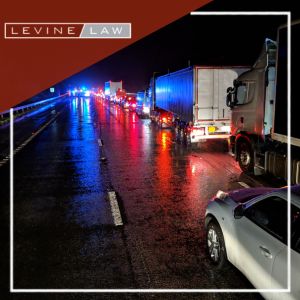
What actually happens after a truck crash in Denver?
The trucking company acts faster than you do. Big carriers send “rapid response” investigators and defense lawyers to the scene, sometimes the same day. Your own crash report from the Denver Police Department or Colorado State Patrol can take several days to finish.
That speed gap matters. The most valuable evidence in a truck case is held by the company.
- The engine control module (ECM) records speed and braking.
- The electronic logging device (ELD) tracks driving hours.
- The driver’s file and the shipping papers also sit with the company. Under routine company rules, some of this data can be erased within days or weeks. That is why a fast spoliation letter (a legal notice telling the company to save evidence) is often the single most important step.
Meanwhile, the company’s insurer may call with a quick, low offer or ask for a recorded statement. You should decline until you have a lawyer.
What are the most common causes of truck accidents in Denver?
Most Denver truck crashes trace back to driver error, company pressure, or equipment failure. Denver’s geography sharpens all three — the I-70 mountain corridor and the congested I-25/I-70 interchange leave a loaded semi with very little room to recover. Here is what usually goes wrong:
- Driver fatigue and hours-of-service violations. Delivery deadlines push drivers past safe limits. Electronic logging device (ELD) logs often show the pattern.
- Loose or overloaded cargo. Shifting loads cause rollovers and jackknife crashes, especially on grades and curves.
- Poor maintenance. Worn brakes and tires are common. Colorado’s Ports of Entry (weigh stations) exist in part to catch these defects.
- Winter weather and chain-law failures. On the I-70 mountain corridor, trucks that skip traction rules lose control on ice and snow. Colorado saw hundreds of traffic deaths in 2024 (IIHS state fatality data).
- Distracted, impaired, or speeding driving. The same negligence that causes car crashes, but with far deadlier force.
Traffic adds to the danger. Denver Vision Zero data shows Denver’s High Injury Network — about 5% of city streets — accounts for a large share of serious crashes.
What types of injuries are common in Denver truck accidents?
A truck weighs far more than a car. So truck crashes tend to cause severe, life-changing injuries. How bad the injury is usually drives both the medical timeline and the value of the claim.
- Traumatic brain injuries (TBI), from concussions to lasting brain damage.
- Spinal cord injuries and paralysis, common in underride and rollover crashes.
- Broken bones in the legs, pelvis, ribs, and arms from hard impacts.
- Internal organ damage and bleeding. These may not show symptoms right away. They need urgent care at a Level I trauma center like Denver Health Medical Center.
- Amputations, severe burns, and in the worst cases, wrongful death.
Some of these injuries show up hours or days later. Prompt trauma care protects both your health and your claim.

Who is liable for a truck accident in Denver?
In a truck crash, more than just the driver might be responsible. Often, several companies and their insurance providers are involved, and a thorough investigation is needed to find everyone who played a part.
Here is who might be to blame:
- The truck driver: If they were driving while distracted, tired, or breaking traffic rules.
- The trucking company: They are responsible for their employees while they are working. They can also be at fault if they hired someone unsafe, failed to train them properly, or didn’t keep the truck in good working order.
- The broker or company shipping the goods: If they scheduled deliveries that were impossible to meet safely or loaded the cargo improperly, causing the crash.
- A part maker: If the crash happened because of a broken part, like faulty brakes or tires.
- Government agencies: If the road was dangerous or poorly designed, the city, county, or state agencies might share the blame. Note that claims against these groups must be filed within 182 days.
How Colorado decides who pays
Colorado uses a system called modified comparative negligence to split the blame. If you are 49% or less at fault, you can still get money, but your total recovery will be reduced by your share of the blame. If you are 50% or more at fault, you cannot get any money.
Colorado also uses pro-rata liability meaning each person or company responsible for the crash only has to pay for their own share of the damages. Because of this, it is very important to identify every person or company that contributed to the accident.


Attorney insight: what makes Denver truck accident cases complex?
Truck cases mix federal rules, multiple company defendants, and technical evidence that disappears fast — which makes them far harder to prove than an ordinary car crash.
Why Denver truck accident claims are complex:
- Several defendants may share fault. The driver, the trucking company, a freight broker, the shipper, and even a parts maker can each be liable. Under C.R.S. § 13-21-111.5, each pays only its own share, so naming every responsible party protects your recovery.
- Federal trucking rules shape the case. FMCSA hours-of-service limits, electronic logging device (ELD) data, and maintenance records are measured against the facts to show a driver or carrier broke the rules.
- The key evidence is technical and short-lived. The engine control module (ECM) “black box” records speed and braking, ELD logs track driving hours, and dashcam video can capture the crash — but all of it sits with the company and can be erased within days or weeks. That is why a fast evidence-preservation (spoliation) letter is often the single most important early step.
- Colorado’s chain law and Ports of Entry records can prove violations. Commercial vehicles at or above 16,001 lbs GVWR must carry chains or approved traction devices on mountain routes from September 1 through May 31, and on I-70 between mile 163 (Edwards) and mile 259 (Morrison), chains are required. More than 1,300 citations were issued in the 2024–25 season, and violations add FMCSA safety points under the Vehicle Maintenance category. Colorado’s Ports of Entry (weigh stations) can also document a truck’s weight and condition close to the time of the crash.
- Government-vehicle or road-defect claims add a hard deadline. If a public entity’s vehicle or a dangerous road played a part, a written notice of claim is due within 182 days — miss it and the claim is barred, no matter the three-year lawsuit deadline.
Breaking these rules is more than just a ticket. Under Colorado law, it can be strong proof that the company or driver was careless. Being “trial ready” means we act quickly to save evidence by sending a legal notice called a spoliation letter. It means we work with experts to figure out how the crash happened and to understand your medical needs. We also use specialists to plan for your future care. Most importantly, we prepare every case as if it will go to court.
What damages can you recover after a Denver truck accident?
In Colorado, if you are injured in a truck accident, there are two types of money (or “damages”) you may be able to recover – economic and non-economic damages.
Economic damages are costs that are easy to add up. There is no legal limit on the amount you can receive for these. These include the following:
- Medical bills: The cost of your care, including future treatment and rehab.
- Lost income: The money you lost because your injuries prevented you from working.
- Property damage: The cost to fix or replace your vehicle and any other property.
On the other hand, non-economic damages are costs for personal losses that are harder to put a price on. There is a legal limit on how much you can receive for these. These include:
- Pain and suffering: The physical pain you feel because of your injuries.
- Emotional distress: The fear, anxiety, or trauma caused by the accident.
- Permanent marks: Scars or other lasting signs on your body from injuries or surgeries.
- Loss of enjoyment: Not being able to participate in the hobbies or activities you used to enjoy.
- Relationship impact: How the accident has negatively affected your relationships with your family.
Legal note on Colorado’s damage caps
For cases filed on or after January 1, 2025, Colorado raised its cap on non-economic damages to $1.5 million under HB 24-1472. This is a big jump from the old limit. Economic damages like medical bills and lost earnings have no cap. This matters a lot in truck cases, where lifetime care can be the highest cost.
In cases of extreme or reckless conduct, you may also recover exemplary/punitive damages (extra money meant to punish very reckless behavior) under C.R.S. § 13-21-102. Careful records and expert life-care planning are what set a fully valued claim apart from an undervalued one.
How long do you have to file a truck accident claim in Colorado?
Colorado usually gives you three years from the crash date to file a truck accident lawsuit (C.R.S. § 13-80-101). That is longer than the two-year limit for most other injury claims. But it is not unlimited.
If the crash caused a death, a wrongful death claim usually must be filed within two years. Deadlines can change in a few cases, such as an injured child or a driver who fled. So confirm your exact deadline early. In truck cases, the real deadline to save evidence is much shorter than three years.
Pitfall alert: waiting lets the truck’s data disappear
The biggest mistake in a Denver truck case is treating the three-year deadline as the only clock to file a lawsuit. If the crash caused a death, you usually have two years. Keep in mind that these deadlines can change—for example, if the person hurt was a child or if the driver fled the scene. Always check your specific deadline as soon as possible.
Warning: Waiting lets important evidence disappear
In terms of securing evidence to support your claim, you do not have that three full years. Why?
- Evidence disappears fast: Information like the truck’s “black box” data, driving logs, and dashcam video can be deleted by the trucking company within just days or weeks.
- The truck might be lost: The vehicle itself could be repaired or sold before anyone gets a chance to inspect it for proof of what happened.
How to stop it? A lawyer can send a legal notice called a spoliation letter. This forces the company to save all evidence so it cannot be destroyed.
Government deadlines are also shorter. If your accident involved a city bus, a state vehicle, or other government property, you have a much stricter deadline. You must file a written notice within 182 days. If you miss this date, you lose the right to sue.
What are the consequences of not reporting a truck accident in Colorado?
Not reporting a crash — or leaving the scene — can bring criminal charges, license penalties, and serious harm to your injury claim.
- Leaving the scene is a crime. Under C.R.S. § 42-4-1601, a hit-and-run ranges from a misdemeanor for property damage to a felony when someone is seriously hurt or killed — with fines, possible jail, and license points.
- The crash must be reported. C.R.S. § 42-4-1606 requires prompt notice to police. In Denver, officers file the Colorado Traffic Crash Report (DR 3447) with the state. If no officer investigates, you generally file your own account — a counter report (form DR 2559) — with the Colorado DMV.
- It weakens your claim. Without an official crash record, insurers are far more likely to dispute fault, and time-sensitive evidence is lost — which matters even more in truck cases where the company controls the data.
Making sure a DR 3447 report exists protects both your license and your ability to recover.
Why do you need a truck accident lawyer in Denver?
A truck case puts you against a company, its insurer, and a defense team. Their job is to pay as little as possible, starting at the scene. A lawyer levels the field by moving fast on evidence and sorting out who is to blame.
- Companies send rapid-response investigators within hours to build a defense before you leave the hospital.
- Their insurers dispute fault, play down real injuries, and push you toward a quick, low settlement.
- Several defendants — driver, company, broker, and parts maker — point fingers at one another. Overlapping policies get complicated fast.
Opponent playbook
In crashes on I-70 or at the I-25/I-70 “Mousetrap” companies often argue that you caused the wreck. They may claim an unsafe lane change into a blind spot, sudden braking, or following too closely. Under Colorado’s 50% bar rule, shifting even part of the fault onto you cuts or ends your recovery. Defense teams also try to blame your injuries on a prior condition.
A lawyer fights back by securing the ECM and ELD data, the driver’s file, the DR 3447 report, and independent witness accounts. A lawyer also hires accident-reconstruction and medical experts before that evidence is lost.
What does the truck accident claim process look like?
Most truck claims follow a clear path. It starts with a consultation, then fast evidence preservation, investigation, a demand, and negotiation. If the company won’t be fair, we file suit in Denver District Court.
- Free consultation. We review the crash, your injuries, and the insurance involved.
- Evidence preservation and investigation. We send spoliation letters and secure the ECM/ELD data, the driver file, and shipping papers. We also gather the DR 3447 report, medical records, and witness statements.
- Demand and negotiation. We send a documented demand to each at-fault party’s insurer and negotiate.
- Settlement or lawsuit. If talks stall, we file suit in the Second Judicial District (Denver District Court, 1437 Bannock St) and prepare for trial.
Timelines vary with how serious the injuries are, how many defendants there are, and the court’s schedule.
How do you choose the right Denver truck accident lawyer?
Look for real experience with truck cases, knowledge of FMCSA rules and Denver courts, the resources to fund expert work, and true trial readiness — not slogans.
-
Does the firm have experience with cases like yours?
Ask whether the firm regularly handles collisions of your type and severity.
For more than 20 years, Levine Law has represented injured people across the Denver metro, including truck and other commercial-vehicle crashes. Our motor-vehicle results include a $770,000 verdict in a truck crash that caused neck, back, and abdominal injuries. See more on our case results page. Past results do not guarantee future outcomes.
-
Do they understand Denver-specific challenges?
An attorney who knows the Second Judicial District‘s procedures and how Front Range insurers operate brings a real advantage.
We know Denver District Court, which serves Colorado’s Second Judicial District. Founder Jordan S. Levine helped set Colorado precedent on holding insurers accountable in Crowell v. ICAO. That same insurer accountability decides most truck claims.
-
Are they trial-ready?
The strongest settlements often come when the insurer knows your lawyer is prepared to go to trial.
Levine Law’s attorneys hold an AV Preeminent rating — Martindale-Hubbell’s highest peer rating for a lawyer’s legal ability and ethical standards. They have also been recognized by Super Lawyers and the National Trial Lawyers. Recognitions reflect each organization’s own selection criteria.
Overall, seek out an attorney with established trial readiness and a history of successful results in the Front Range, rather than selecting a firm based on marketing slogans or flashy advertising.
Client testimonials
Our clients often describe steady communication and close attention after a serious crash.
“I was T-Boned and my truck totaled while traveling to Buckley AFB for work. My truck never made it home but I did with moderate injuries to my hand, shoulder and neck that lasted weeks. My injuries started to hurt much worse a couple days after the wreck and it became clear I would have to get treatment. Being from out of state I needed someone to represent me in CO and found Levine Law online. I worked with Sarah Freedman and Jessa Boles entirely through phone and email, and could not have been happier.
The thing we all want when hiring a lawyer is someone who will listen to and take your case as seriously as you do. Perhaps most importantly for me I needed someone to help walk me through all the steps since it was my first real accident with injuries. When you’re trying to balance the hassle of finding a new vehicle and getting treatment it can be difficult to know what to do next to make sure you’re protected. Sarah did a fantastic job explaining things to me every step of the way.
The customer service I experienced with this firm I would wish every company could live up to. Every time I’ve called they’ve done everything to help me and answer my questions and are all very nice people. Having to do all my work with them through Phone and E-mail and still feel like they know me and actually care about my case was a big deal for me. Could not recommend more highly.” — Greg S., Yelp review
You can read verified reviews on our Levine Law Reviews page.
Disclaimer: Client reviews are individual experiences and are not a guarantee of any particular result.
Case results that reflect real experience
Levine Law has represented Denver-area clients in serious motor-vehicle and commercial-vehicle cases. We focus on securing money for medical care, lost income, and long-term recovery.
- $1.3 million settlement — a driver ran a red light and struck the client, breaking his leg.
- $770,000 verdict — a truck accident that caused neck, back, and abdominal injuries.
- $256,000 verdict — a rear-end collision in which the client’s neck injury affected his vision.
More outcomes are listed on our Cases & Verdicts page.
Disclaimer: Prior results do not guarantee a similar outcome; every case is decided on its own facts.
Areas served
Levine Law represents truck accident victims across the Denver metro and Front Range, including:
We also handle related truck matters, including jackknife truck accidents and underride truck accidents. We take car accidents, motorcycle accidents, and rideshare accidents too.
Local resources
Hospitals & Emergency Care in Denver
- Denver Health Medical Center — the only Level I trauma center in the City of Denver; 777 Bannock St, Denver, CO 80204
- Saint Joseph Hospital — 1375 E 19th Ave, Denver, CO 80218
- HCA HealthONE Rose Medical Center — 4567 E 9th Ave, Denver, CO 80220
- HCA HealthONE Presbyterian/St. Luke’s Medical Center — 1719 E 19th Ave, Denver, CO 80218
Crash reports & agencies
- Denver Police Department Records — accident reports; records line 720-913-6029
- Colorado DMV — Report a Crash
- Colorado Department of Transportation
Courts
- Denver District Court (Second Judicial District) — City and County Building, 1437 Bannock St, Denver, CO 80202
Disclaimer: We provide these resources for convenience only; we do not endorse or profit from them.
Frequently asked questions
How long do I have to file a truck accident claim in Colorado?
You usually have three years from the crash date under C.R.S. § 13-80-101. But claims against a public agency like RTD or CDOT need a written notice within 182 days. Trucking evidence like ELD logs can vanish much sooner, so act quickly.
What evidence is unique to a Denver truck accident case?
Truck cases rely on evidence the company controls. That includes the engine control module (“black box”), the ELD driving-hours records, the driver’s file, maintenance records, and shipping papers. Because FMCSA rules and company retention schedules govern this data, a fast spoliation letter is often essential.
Who can be held liable besides the truck driver?
The trucking company can be liable through respondeat superior (an employer is responsible for what its workers do on the job). It can also be directly at fault for poor hiring or maintenance. Each party’s share is set by C.R.S. § 13-21-111.5. Brokers, shippers, and parts makers may share fault too.
What federal and state regulations apply to Denver truck accidents?
Interstate carriers must follow FMCSA rules on driving hours, electronic logging devices, maintenance, and driver qualifications. Colorado adds its chain law and Ports of Entry weight checks. Breaking one of these rules is more than a ticket — it can be strong evidence of negligence, as explained in the attorney insight above.
Does Colorado’s chain law affect my truck accident claim?
It can. On I-70 between mile 163 and mile 259, commercial vehicles must carry chains from September 1 to May 31. Violations add FMCSA safety points. If a truck lost control on ice without required traction devices, that can be strong evidence of negligence under Colorado law.
How much does a Denver truck accident lawyer cost?
Levine Law works on contingency. There is no upfront cost to hire us, and we front the expenses of expert-heavy truck cases. Attorney’s fees are a percentage of the settlement or verdict and are owed only if we win for you. That is our “No Win, No Fee” promise.
Contact a Denver truck accident lawyer today
If you or a family member was hurt in a Denver-area truck crash, Levine Law is here to help. We are available 24/7 to review your claim, move fast to save evidence, and explain your options at no cost.
Call 303-333-8000 or contact us online for a free, no-obligation consultation.
Attorney Review Disclosure
This content has been reviewed by the attorneys at Levine Law to help ensure its accuracy and compliance with applicable Colorado law. Legal services are provided by attorneys licensed to practice in the State of Colorado.
Denver Office
Levine Law LLP
4500 Cherry Creek S Dr #400
Denver, CO 80246
24/7 Hotline: (303) 333-8000
Other Cases We Take On
Beyond truck accidents, Levine Law helps injured Coloradans across many practice areas:
- Car Accidents
- Motorcycle Accidents
- Uber & Lyft / Rideshare Accidents
- Pedestrian Accidents
- Bicycle Accidents
- Slip & Fall Accidents
- Premises Liability
- Traumatic Brain Injuries
- Spinal Cord Injuries
- Wrongful Death
- Nursing Home Abuse
- Catastrophic Injury
This content is for informational purposes only and does not constitute legal advice. Reading it does not create an attorney-client relationship. Past results do not guarantee future outcomes; every case is evaluated on its own facts. This content has been prepared for review by Colorado-licensed attorneys at Levine Law.


