


What happens when a trucking company’s insurer tries to pin the crash on you?It’s the first move in almost every Glendale truck claim: the company’s insurer and investigators arrive at the scene fast, looking for anything that shifts blame your way. A Glendale personal injury lawyer can challenge those tactics by investigating the crash, preserving evidence, and building a strong case for liability. That matters because Colorado’s comparative negligence rule (C.R.S. § 13-21-111) divides your medical costs and lost income by assigned fault—so every percentage point the insurer pins on you can reduce your recovery. Because Glendale sits in Arapahoe County, this personal injury claim would be filed in the 18th Judicial District, not Denver. |
|---|
Federal regulation (23 C.F.R. § 658.13) bars states from limiting a semi-trailer to less than 48 feet — a length most states allow in full, putting a fully loaded rig well over three times the length of the car it collides with, and slower to turn, merge, or brake than most drivers expect. However, insurers rarely dispute that math; they dispute everything else — who was at fault, how bad the injuries really are, which company should pay. Sorting that out while you’re also trying to recover physically is a lot to carry on your own, which is where a personal injury lawyer earns their keep.
- 20+ years in Colorado injury law: Founder Jordan S. Levine has led Levine Law for more than two decades, representing hurt people across the Denver metro and Arapahoe County. Learn about our firm and the team who would handle your case.
- A verifiable track record: Multi-million-dollar case results and verdicts, and client reviews from the people we’ve represented.
- Built for multi-defendant cases: Truck claims usually mean more than one insurer at the table — the driver, the carrier, sometimes a broker — and we take them on contingency, so you pay no fee unless we win.
- Reach out at no cost: Contact our Denver office, and see the awards and recognition our attorneys have earned.
You have three years to file a Colorado truck crash lawsuit (C.R.S. § 13-80-101), and that deadline got more valuable in 2025, when the pain-and-suffering cap rose to $1.5 million. None of that changes how fast a carrier’s own records can disappear, though — under routine retention rules, the data a case often turns on can be gone in days or weeks, long before that three-year window is anywhere close to running out.
What should you do immediately after a truck accident in Glendale?
Medical care comes first — call 911 and get checked out before anything else. Once that’s underway, who shows up to investigate depends on exactly where the crash happened: Glendale Police Department on city streets, or Colorado State Patrol if it’s on I-25 just south of the city. Either way, get the truck, the driver, and the company’s information written down before you leave the scene, since the resulting Colorado Traffic Crash Report (DR 3447) can take days to become available — you can request a copy later through the Colorado DMV’s crash-records portal.
The first hour of a truck case shapes everything that follows. Here is how to protect your claim:
- A prompt report isn’t optional. C.R.S. § 42-4-1606 requires it for any crash involving injury, death, or property damage, and on I-25 that means Colorado State Patrol is typically the agency filing the DR 3447.
- Don’t skip the trauma center just because you feel okay. Internal truck-crash injuries frequently take hours to surface, and by the time they do, the gap in your medical records can already be working against you — Rose Medical Center is the closest ER, with Denver Health as the nearest Level I trauma center.
- The truck itself is evidence — document it before it leaves. Plates on the tractor and trailer, the USDOT number stenciled on the cab door, the carrier’s name, any placards: all of it helps a lawyer trace the company and its insurer later.
- Vague location descriptions cost cases. “Near the Colorado Boulevard exit on I-25 southbound” or “South Colorado Boulevard at Leetsdale Drive” gives an investigator something to work with; “somewhere on I-25” doesn’t.
- Witnesses disappear fast — get their information while they’re still there. When the drivers’ accounts don’t match up later, an independent witness is often what breaks the tie.
What actually happens after a truck crash in Glendale?
Glendale is barely a square mile, entirely surrounded by Denver, which means the crash report itself can come from Glendale Police, from Colorado State Patrol on nearby I-25, or occasionally both — a jurisdictional wrinkle most cities this size don’t have. The electronic logging device (ELD) is usually where the case gets won or lost first. It timestamps exactly how long the driver had been on the road before the crash, and unlike a police report that can take days to finalize, that record sits entirely in the company’s hands from minute one.
That’s what makes the first move an insurer makes so predictable. A low offer or a request for a recorded statement typically shows up before you’ve even seen a doctor a second time — both are optional, and neither should be accepted without a lawyer reviewing the ELD and engine control module (ECM) data first, since retention rules let a carrier lawfully erase both within days or weeks. An early spoliation letter is what stops that clock.


What are the most common causes of truck accidents in Glendale?
Driver error, company pressure to hit delivery deadlines, and equipment that should have been pulled from service — those three cover most Glendale truck crashes. Glendale’s geography makes them worse: at one square mile and surrounded entirely by Denver, every delivery truck serving the city has to squeeze onto the same handful of tight arterials — Colorado Boulevard, Leetsdale Drive — that also carry the neighborhood’s commuter traffic, with I-25 feeding more of both from just south of the city line.
- Equipment that failed before the crash, not because of it. Worn brakes and tires are the most common culprits, and Colorado’s Ports of Entry weigh stations exist specifically to catch them before a truck like this reaches a city street.
- A driver working past the point of safe reaction time. Hours-of-service violations tend to leave a paper trail in the electronic logging device (ELD) logs, since delivery schedules routinely push drivers closer to the legal limit than they should be.
- Cargo that shifts because it was never secured properly. A loose or overloaded trailer is a common trigger for rollovers and jackknife crashes alike, and Glendale’s tight turns give a shifting load less room to correct itself.
- A carrier that ignored the chain law upstream. Trucks that skip required traction devices on the I-70 mountain corridor before ever reaching the metro can carry that unresolved violation into a crash that happens miles away, on a street that never saw snow.
- Ordinary negligence — distraction, impairment, speed — magnified by size. It’s the same behavior behind most car crashes, just with a force multiplier attached.
What types of injuries are common in Glendale truck accidents?
Common injuries in Glendale truck accidents include traumatic brain injuries, spinal cord injuries, fractures, internal bleeding, organ damage, and other catastrophic injuries.
Force doesn’t negotiate. A loaded tractor-trailer can run 80,000 pounds against a passenger car’s 4,000, and that ratio is why the list below skews toward the permanent end — and why the medical picture, more than any other single factor, ends up driving what a claim is worth:
- Head trauma, from a concussion that clears in weeks to a traumatic brain injury that reshapes the rest of someone’s life.
- Spinal cord injuries, including the paralysis that underride and rollover crashes are notorious for causing.
- Fractures — pelvis, ribs, femur, arms — driven by the sheer force of the impact.
- Internal bleeding and organ damage that stay hidden at first. This is the category that sends people home feeling fine, and it needs trauma-center imaging: Rose Medical Center or Denver Health for the most serious cases.
- Catastrophic outcomes — amputation, severe burns, and wrongful death.
Some injuries take hours or days to show themselves fully. Getting checked out early is what ties them to the crash for both your recovery and your claim.
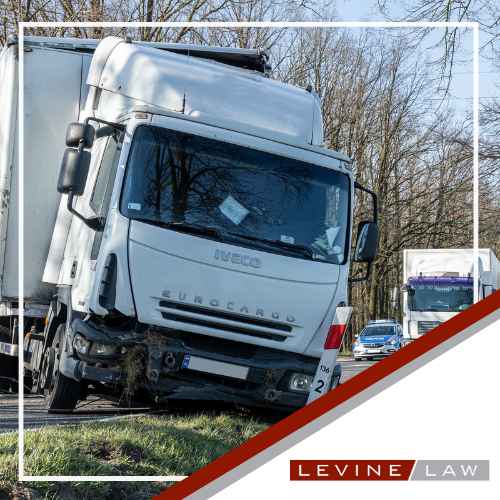
Who is liable for a truck accident in Glendale?
Liability for a Glendale truck accident can fall on the truck driver, trucking company, shipper or broker, vehicle or parts manufacturer, or a government entity responsible for the roadway, depending on what caused the crash.
Because Glendale sits in Arapahoe County, a truck claim filed here can pull in defendants well beyond the driver, each insured on its own separate policy. Tracing the full chain of responsibility usually turns up:
- The driver, for how the truck was being operated. Distraction, impairment, fatigue, or ordinary carelessness behind the wheel all land on the person in the cab.
- The carrier, on two independent theories. Vicarious liability — the doctrine of respondeat superior, meaning an employer answers for what its workers do on the job — covers the driver’s conduct during a shift. Separately, the company can be directly at fault for a driver it should never have hired, training it never provided, or maintenance it chose to defer.
- Whoever scheduled or loaded the freight. A broker’s delivery timeline or a shipper’s loading decision is sometimes the real cause of a crash the driver had no way to avoid.
- The maker of the component that failed. Brakes, tires, or coupling hardware that gave out under normal use moves responsibility onto the manufacturer.
- A public entity, when the road itself played a part. The City of Glendale, the Regional Transportation District (RTD), or the Colorado Department of Transportation (CDOT) can share fault for dangerous roadway conditions — but those claims run through the Colorado Governmental Immunity Act, which requires written notice within 182 days (C.R.S. § 24-10-109).
Two statutes decide what actually lands in your pocket at the end of a Glendale truck case. C.R.S. § 13-21-111 sets the ceiling: cross the 50%-fault line, and the case is worth zero, no matter how badly you were hurt.
C.R.S. § 13-21-111.5 sets the floor: even with liability established, a defendant only pays for the percentage of fault assigned to them specifically, so a driver found 100% liable doesn’t cover a broker’s share if the broker was never named in the suit.
Attorney insight: what makes Glendale truck accident cases complex?
What separates a truck claim from a car-accident claim is the combination: a federal regulatory layer sitting on top of Colorado law, a set of corporate defendants who each arrive with their own counsel, and the most important evidence in the case sitting on a deletion schedule.
Why Glendale truck accident claims are complex:
- FMCSA rules on hours of service, electronic logging device (ELD) recordkeeping, maintenance, and driver qualifications set the floor before Colorado law ever applies. A carrier’s CSA/SMS safety score — its own federal violation history — often ends up doing part of the proving for you, since a poor score can support the argument that this crash wasn’t a one-off.
- A fast spoliation letter is worth more than almost any other early step. The electronic control module (ECM) “black box,” ELD logs, and dashcam footage all sit with the company, and retention rules let it erase all of them within days or weeks — a legal notice demanding preservation is what buys the time to build the case properly.
- Colorado’s pro-rata liability statute rewards naming every possible defendant. C.R.S. § 13-21-111.5 caps each one’s payment at its own share, so a freight broker or parts maker left off the claim isn’t a technicality — it’s recovery that’s permanently gone.
- Chain-law citations create a paper trail before your crash even happens. More than 1,300 were written along I-70 between mile 163 (Edwards) and mile 259 (Morrison) in the 2024–25 season alone, since any commercial vehicle at or above 16,001 lbs GVWR has to run chains or approved traction devices there from September 1 through May 31 — and a Ports of Entry weigh-station record showing a truck’s weight and condition near the time of the crash can end up corroborating exactly that kind of prior violation.
- A public entity in the mix runs on an entirely different calendar. Written notice is due within 182 days whenever an RTD bus or a City of Glendale vehicle contributed to the crash — a deadline that has nothing to do with, and doesn’t wait for, the three-year lawsuit window.
Breaking one of these rules is more than a ticket. Under Colorado law, it can be strong evidence that the company or driver failed its duty of care.
Trial readiness is the posture that makes the rest of it work: evidence frozen by spoliation letter, reconstruction and medical experts retained early, long-term consequences documented by a life-care planner, and the entire file built from day one on the assumption a jury may eventually read it.
What is a Glendale truck accident claim worth?
C.R.S. § 13-21-102.5 draws the line that shapes every truck-crash claim: economic damages, the losses with a dollar figure already attached, are uncapped, while non-economic damages — the personal, non-financial toll — are capped by that same statute.
What falls under economic damages:
- Medical expenses, already incurred and reasonably expected in the future, from the ER through rehabilitation.
- Wage loss, covering income missed to date and any long-term hit to your earning capacity.
- Property and vehicle costs, including repairs, replacement, a rental car, and other related out-of-pocket expenses.
What falls under non-economic damages:
- Emotional distress — the fear, anxiety, and trauma that follow a serious crash.
- Pain and suffering — the physical pain caused by your injuries.
- Scarring and disfigurement — permanent marks left by the crash or the surgery used to treat it.
- Loss of companionship — the toll the injury takes on your relationships with family.
- Loss of enjoyment of life — losing the ability to enjoy the activities and routines you had before the crash.
A truck crash serious enough to reach the 18th Judicial District rarely fits neatly into one bucket or the other. A client with a spinal cord injury, for instance, is usually carrying both a lifetime of medical bills and a real, provable loss of enjoyment of life. A claim that only pursues one of the two can leave significant losses unaddressed.
A Glendale truck accident lawyer can help identify and document both economic and non-economic damages, work with medical and financial professionals to evaluate future losses, and negotiate with the insurer for full compensation. If the insurer refuses to make a fair offer, your attorney can take the necessary steps to pursue your claim in court.
Legal note on Colorado’s damage caps
For cases filed January 1, 2025 or later, HB 24-1472 put the non-economic ceiling at $1.5 million — but that number only limits one side of the ledger. A client with a spinal cord injury requiring lifetime care can easily see six or seven figures in economic damages alone, entirely uncapped, before non-economic damages even enter the calculation. And where a carrier ignored FMCSA rules or drove impaired, C.R.S. § 13-21-102 adds a third, separate category: exemplary damages, awarded to punish, not to compensate.

How long do you have to file a truck accident claim in Colorado?
A truck crash lawsuit in Colorado carries a three-year filing deadline (C.R.S. § 13-80-101) — a full year longer than the two-year window most other injury claims get. That extra year is not a reason to relax.
Wrongful death is the exception that shortens it: two years when the crash killed someone. A few situations move the date the other way, including an injured child or a driver who left the scene, which is why the only deadline worth relying on is one confirmed against your own facts. And none of these is the deadline that usually decides a truck case — the evidence clock runs far shorter than any of them.
Pitfall alert: waiting lets the truck’s data disappear
If an RTD bus was anywhere near your crash, the clock that actually matters isn’t the three-year one — it’s the Colorado Governmental Immunity Act’s 182-day notice requirement, and it runs no matter how much of the three-year window is left.
Beyond that government-entity trap, the more common one is simply assuming the evidence will still be there when you’re ready to deal with it. It usually isn’t: a carrier can lawfully erase electronic control module (ECM), electronic logging device (ELD), and dashcam data under its own retention schedule, and the truck itself can be repaired or resold before anyone inspects it. A spoliation letter sent in the first days after the crash is the only reliable way to freeze both problems at once.
Why do you need a truck accident lawyer in Glendale?
Three separate parties — the trucking company, its insurer, and whatever defense counsel they’ve hired — are all pursuing the same single goal: paying you as little as they can get away with. Here’s what that actually looks like in practice:
- Glendale’s overlap with Denver and I-25 means more than one agency could have investigated your crash, and sorting out which report and which jurisdiction controls your claim isn’t something to figure out alone.
- Insurers routinely dispute fault, understate real injuries, and dangle a fast, low settlement before the case is fully valued.
- Every additional defendant found is leverage your side gains and the other side loses — and finding them takes resources most people don’t have on their own.
How a truck accident lawyer can help
- Investigate before evidence disappears. Your lawyer can secure crash reports, surveillance footage, vehicle data, ELD records, and other evidence that may establish what happened.
- Identify every potentially liable party. A lawyer can investigate the driver, trucking company, broker, shipper, maintenance providers, and manufacturers to determine who may share responsibility.
- Counter the insurer’s arguments. Instead of accepting claims that your injuries were pre-existing or that you caused the crash, your attorney can use medical records, witness statements, accident evidence, and expert analysis to challenge those arguments.
- Build the full value of your claim. Your lawyer can document medical expenses, lost income, future losses, pain and suffering, and other damages rather than allowing the insurer to undervalue your recovery.
- Handle negotiations and prepare for trial. If the insurer refuses a fair settlement, your attorney can use the evidence gathered during the investigation and take the case to court when necessary.
Opponent playbook
More often than not, the first defense out of a trucking company’s mouth has nothing to do with the crash itself: it’s that your own pre-existing back or neck condition, not the collision, explains what shows up on your MRI. Medical records pulled early — showing what your health looked like before the crash — are usually what closes that argument down for good. If that fails, expect the fallback: an unsafe lane change, hard braking, or following too close, pinned on you specifically because Colorado’s 50% bar rule means even a partial share of fault can zero out your payout entirely. The electronic control module (ECM) and electronic logging device (ELD) data, secured before it’s erased, is usually the difference between that argument working and not.
What does the truck accident claim process look like?
A Glendale truck accident claim generally moves through four stages: an initial consultation, preserving and gathering evidence, making a settlement demand, and resolving the case through negotiation or trial. The second stage is often where a truck case is won or lost because critical evidence can disappear if it is not secured quickly.
- The consultation, at no cost. We go through how the crash happened, what injuries you’re dealing with, and which policies are actually in play.
- Locking down the evidence. Spoliation letters go out immediately, followed by the electronic control module (ECM) and electronic logging device (ELD) data, the driver’s qualification file, and the shipping paperwork. The DR 3447, your medical records, and witness accounts get pulled in alongside them.
- The demand. Each liable party’s insurer receives a documented valuation of the claim, and negotiation starts from there.
- Resolution — or the courthouse. When an insurer won’t move, the case is filed in the 18th Judicial District (Arapahoe County District Court, 7325 S Potomac St, Centennial) and worked up for trial.
How long all of it takes depends on the severity of the injuries, the number of defendants, and how booked the court’s calendar is.
How do you choose the right Glendale truck accident lawyer?
Choosing the right Glendale truck accident lawyer means looking beyond a firm’s website to its verifiable results, local court knowledge, trial experience, and fee structure.
Every firm’s website reads well. What actually differs is what happens once you ask for specifics — start with these four:
- Can you actually verify the firm’s truck-case results?
Anyone can claim experience; not every firm can point to a number. Levine Law’s motor-vehicle results include a $770,000 verdict from a truck crash that caused neck, back, and abdominal injuries, listed alongside the rest on the case results page rather than just described in a sales pitch — and founder Jordan S. Levine has his own track record of setting statewide precedent on insurer accountability in Crowell v. ICAO. Past results do not guarantee future outcomes.
- Does the attorney know how the 18th Judicial District actually handles a Glendale claim?
A Glendale truck claim that goes to trial lands in Centennial, not downtown Denver — different judges, different jury pool, different local rules. That distinction matters more than most firms let on.
- Is the firm’s trial reputation backed by outside recognition?
An AV Preeminent rating comes from other lawyers’ peer review, not self-promotion — it’s Martindale-Hubbell’s highest rating for legal ability and ethics. Levine Law’s attorneys hold it, plus recognition from Super Lawyers and the National Trial Lawyers, though each group applies its own criteria.
- Is the fee structure clear from the very first conversation?
It should be, before you sign anything. Levine Law’s contingency arrangement means no fee unless the case wins, and the first consultation is free.
Client testimonials
Reviews like this one are why people call us after a referral, not just after a Google search.
“The attorneys at Levine Law did an excellent job helping me navigate my accident in a clear, professional, and personal manner.” — Joseph Hurtado, Google review.
You can read verified reviews on our Levine Law Reviews page.
Disclaimer: Client reviews are individual experiences and are not a guarantee of any particular result.
Case results that reflect real experience
Insurers fight hardest when the injuries are worst, and truck cases bring both in full measure. A sample of what that’s produced:
- $1.8 million, plus $185,000 for her husband — a teacher and husband, both injured in the back after being rear-ended by a truck; she through multiple surgeries, he through one.
- $770,000 verdict for neck, back, and abdominal injuries from a truck crash.
- $2.6 million settlement for a mechanic left partially paralyzed in a rollover crash, secured despite the insurer’s initial attempt to deny the benefits.
More outcomes are listed on our Cases & Verdicts page.
Disclaimer: Prior results do not guarantee a similar outcome; every case is decided on its own facts.
Areas served
Levine Law represents truck accident victims across the Denver metro and Front Range, including:
We also handle related truck matters, including jackknife truck accidents and underride truck accidents. We take car accidents, motorcycle accidents, and rideshare accidents, too.
Local resources
Hospitals & Emergency Care Near Glendale
- HCA HealthONE Rose Medical Center — nearest ER, minutes from Glendale; 4567 E 9th Ave, Denver, CO 80220
- Denver Health Medical Center — nearest Level I trauma center; 777 Bannock St, Denver, CO 80204
- Swedish Medical Center — Level I trauma center in nearby Englewood, CO
Crash reports & agencies
- Glendale Police Department (303-759-1511) — investigates Glendale city-street crashes.
- Colorado State Patrol — I-25 crash investigation and chain-law enforcement
- Colorado DMV — Crash Records — request your Colorado Traffic Crash Report (DR 3447)
- Colorado DMV — Report a Crash
- Colorado State Patrol — Chain Law Information
Courts
- Arapahoe County District Court (18th Judicial District) — 7325 S Potomac St, Centennial, CO 80112
Disclaimer: We provide these resources for convenience only; we do not endorse or profit from them.
Frequently asked questions
How long do I have to file a truck accident claim in Colorado?
Three years from the crash date is the standard rule under C.R.S. § 13-80-101 — but that’s the outer limit, not a safe target. An RTD bus in the mix shrinks it to a 182-day written-notice deadline, and the electronic logging device (ELD) and electronic control module (ECM) data a truck case actually depends on can be gone within days or weeks regardless of which deadline applies to you.
What evidence is unique to a Glendale truck accident case?
The electronic logging device (ELD), since it timestamps exactly how long the driver had been working before the crash — a detail no car-accident case has to prove. Add to that the electronic control module (ECM)‘s speed and braking data, the driver’s personnel file, and the carrier’s maintenance and shipping records, all of it subject to FMCSA-mandated retention schedules that let a company legally delete it within weeks. That’s the entire reason spoliation letters exist in truck litigation and rarely come up in an ordinary crash case.
Who can be held liable besides the truck driver?
The trucking company itself, through respondeat superior, or directly for hiring or maintenance failures it made on its own. A freight broker or shipper if bad scheduling or improper loading played a role. A parts manufacturer if defective brakes or coupling gear caused the crash. Colorado’s pro-rata rule means a thorough investigation — one that actually names every liable party — is what separates a full recovery from a partial one.
What federal and state regulations apply to Glendale truck accidents?
Two layers, stacked on top of each other. Colorado’s own rules — the chain law and Ports of Entry weight checks — sit on top of a federal floor set by FMCSA, which governs driving hours, electronic logging, maintenance, and driver qualifications regardless of which state the truck is in. A violation of either layer can become evidence of negligence, as explained in the attorney insight above.
Does Colorado’s chain law affect my truck accident claim?
It often does, even for a crash that happens entirely within Glendale. Plenty of Front Range trucking routes run through the I-70 mountain corridor before ever reaching the metro, so a carrier that skipped required chains upstream between September 1 and May 31 can be carrying an unresolved safety violation into a crash that occurs miles away — and under Colorado law, that violation can stand as strong evidence of negligence.
How much does a Glendale truck accident lawyer cost?
Nothing upfront, and nothing at all unless you win. Truck cases run expensive — accident reconstructionists, life-care planners, medical experts — and Levine Law fronts those costs, recovering an agreed percentage of the settlement or verdict only if the case succeeds.
What’s a realistic settlement range for a Glendale truck accident case?
There’s no fixed number — it moves with the injury, how many defendants share the fault, and how well the economic losses are documented. To give a sense of the spread: our motor-vehicle results include a $770,000 verdict for neck, back, and abdominal injuries and a $2.6 million settlement for a rollover crash that left a client partially paralyzed, even after the insurer first tried to deny the claim (full list on case results; prior outcomes never guarantee a future one). Only a free case review can put a number on your own crash.
Contact a Glendale truck accident lawyer today.
A free consultation costs you nothing and takes minutes — and it’s the fastest way to find out whether the deadline that actually applies to your Glendale truck crash is three years, 182 days, or something shorter still.
Contact us online for a free, no-obligation consultation.
Attorney Review Disclosure
This content has been reviewed by the attorneys at Levine Law to help ensure its accuracy and compliance with applicable Colorado law. Legal services are provided by attorneys licensed to practice in the State of Colorado.
Denver Office
Levine Law LLC
4500 Cherry Creek S Dr #400
Denver, CO 80246
24/7 Hotline: (303) 333-8000
Other Cases We Take On
Beyond truck accidents, Levine Law helps injured Coloradans across many practice areas:
- Car Accidents
- Motorcycle Accidents
- Uber & Lyft / Rideshare Accidents
- Pedestrian Accidents
- Bicycle Accidents
- Slip & Fall Accidents
- Premises Liability
- Traumatic Brain Injuries
- Spinal Cord Injuries
- Wrongful Death
- Nursing Home Abuse
- Catastrophic Injury
This content is for informational purposes only and does not constitute legal advice. Reading it does not create an attorney-client relationship. Past results do not guarantee future outcomes; every case is evaluated on its own facts. This content has been prepared for review by Colorado-licensed attorneys at Levine Law.


