


If you were rolling through a stop sign under Colorado’s Safety Stop law when a driver hit you, are you automatically at fault?Not necessarily. Colorado’s Safety Stop law (C.R.S. § 42-4-1412.5) allows a cyclist who is 15 or older, or under 15 who’s accompanied by an adult, to proceed through certain stop signs at 10 mph or less after yielding as required by the statute. Following those conditions does not automatically make the cyclist responsible for a later collision. If the driver also failed to yield, failed to see the cyclist, or otherwise contributed to the crash, those facts can factor into the fault analysis. A Lakewood personal injury lawyer can review the traffic conditions, right-of-way, vehicle movements, and other evidence to determine how Colorado’s comparative negligence rules may apply. |
One second you’re pedaling through a green light. Then the next second, a driver is climbing out of a car that turned right without checking a mirror. Now an adjuster wants to know whether you had the right of way, whether you signaled, whether you were really riding where Colorado law says you belong. Some of those questions carry real legal weight. Others are just the adjuster hoping you don’t know your rights well enough to push back.
A lawyer fluent in Colorado’s cycling laws won’t let an adjuster’s assumptions go unchallenged. What that looks like in practice at Levine Law:
- 20+ years in Colorado crash claims. Founder Jordan S. Levine has led the Levine Law team through two decades of cases, including plenty where a cyclist’s right of way was disputed after the fact.
- A results record you can check yourself. Browse the firm’s case results and verdicts, including multi-million-dollar recoveries for injuries as serious as a bad bicycle crash tends to produce.
- Bicycle claims are one part of a broader crash practice. Levine Law takes them on the same contingency terms as every other crash case it handles. Learn more about the firm.
- Watch the filing deadline — it can be shorter than you’d think. Three years covers most Lakewood bicycle claims, but that drops to two if no motor vehicle was involved. Connect with us for a free consultation before that window closes.
What should you do after a bicycle accident in Lakewood?
Get medical care first, even if you feel steady enough to ride home. Adrenaline can hide a real injury for hours. Once you’re checked out, focus on the evidence that won’t still be there tomorrow.
- Get checked out at an ER, not just urgent care. A road-rash scrape or a broken wrist is easy to spot. A concussion or an internal injury usually isn’t, at least not immediately.
- Photograph the bike, your gear, and the intersection. A bent wheel, a cracked helmet, or the exact position of a stop sign can matter later, and none of it stays put for long.
- Get a police report, even for a crash that looks minor. Colorado’s crash-reporting statute (C.R.S. § 42-4-1606) requires one for any crash that injures someone or significantly damages property. Note whether you had a green light, a yield, or the right of way. The Lakewood Police Department handles most city-street crashes, while Colorado State Patrol covers state highways like US 6 and C-470.
- Collect contact information before witnesses scatter. The driver, any passengers, and anyone who saw the crash happen are all worth having on hand later.
- Hold off on a recorded statement until a lawyer’s involved. A seemingly casual question about your speed or the line you rode through the intersection can quietly be building a case that the fault was yours.
What actually happens after a bicycle crash in Lakewood?
After a Lakewood bicycle crash, the immediate priorities are getting medical attention, documenting what happened, and preserving evidence that may later help establish how the collision occurred. From there, the claim usually develops as medical records, crash evidence, insurance information, and the longer-term effects of the injury become clearer. The process can take time because important questions, particularly about right-of-way and fault, may not be answerable from the initial crash report alone.
What happens in the days and weeks after the crash?
- The crash is documented. Law enforcement may record the location, traffic controls, statements, vehicle movements, and other circumstances surrounding the collision. Photographs, witness information, bicycle damage, and available video can provide additional evidence about what happened.
- Medical treatment begins or continues. Medical records can establish the nature of the injuries and how they developed over time. Keeping records of appointments, treatment, restrictions, and expenses can also help document the effect of the injury beyond the initial emergency visit.
- The evidence is preserved. A damaged bicycle, helmet, clothing, lights, or other equipment may contain information relevant to the collision or the severity of the impact. Photos and the physical items themselves can become important if questions later arise about how the crash happened.
- The longer-term effects become clearer. Some injuries resolve quickly, while others require rehabilitation or leave lasting limitations. Understanding the likely course of treatment can matter when evaluating damages, particularly when an injury affects work, mobility, or everyday activities.
- The insurance claim develops. Insurers may investigate the collision, review medical records, assess property damage, and ask questions about how the crash occurred. If fault is disputed, evidence concerning traffic signals, right-of-way, speed, visibility, and each person’s actions can become particularly important.
None of this gets explained to you automatically by the other side. That’s precisely why getting the earliest stage right matters more than any stage after it.
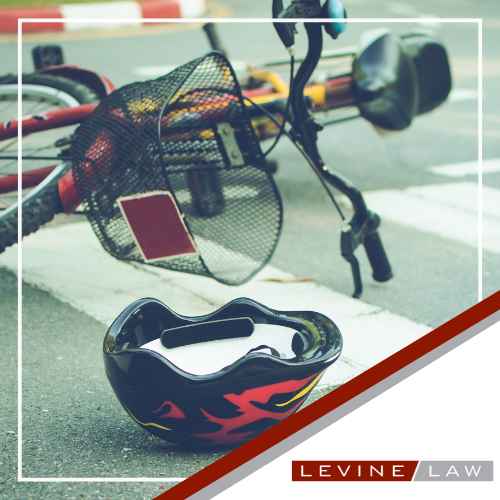
What usually causes bicycle accidents in Lakewood?
Most bicycle crashes trace back to a driver misjudging where a cyclist is about to be, especially at an intersection. Lakewood adds its own version of that problem. Wide, fast arterials like Colfax Avenue and Alameda Avenue cross paths with popular cycling routes like the Bear Creek Trail. The ongoing US 6 and Wadsworth reconstruction has also added detours that put cyclists and cars in closer contact than usual.
- Right-hook turns. A driver turning right crosses directly into a cyclist’s path, often because the driver never checked for a bike alongside the car.
- Left-cross turns. A driver turning left misjudges an oncoming cyclist’s speed, the same way many drivers misjudge a motorcycle’s.
- Dooring. Colorado law (C.R.S. § 42-4-1207) requires a driver to check that it’s safe before opening a door into traffic. A door that opens into a bike lane or the road’s edge can put a cyclist down with no warning at all.
- Unsafe passing. Colorado’s three-foot law (C.R.S. § 42-4-1003) requires drivers to give a cyclist at least three feet of space when passing. Narrow lanes on older Lakewood streets make that margin easy to shave.
- Intersection confusion, sometimes made worse by drivers who don’t expect a cyclist to legally roll through a stop sign under the Safety Stop law described above.
What injuries come up most often in these crashes?
These injuries tend to run more severe than injuries from an ordinary car crash. A cyclist has no frame, airbag, or seatbelt, and a hard stop can launch a rider over the handlebars instead of just forward in a seat. If injured, you can go to St. Anthony Hospital; it sits inside Lakewood itself and is a Level I trauma center.
- Fractures to the collarbone and wrist are common when a rider goes over the handlebars and instinctively braces for the fall.
- Road rash and lacerations, which can go deep enough to need skin grafts even when no bone is broken.
- Traumatic brain injuries, ranging from a mild concussion to damage that lasts well past the ER visit, often worse without a helmet.
- Spinal cord injuries from a hard impact to the back, including partial or complete paralysis in serious cases.
- Internal injuries, which often show no outward sign at the scene. That’s exactly why a same-day trauma evaluation catches what a glance wouldn’t.
Tell a provider about every symptom the moment it shows up, even one that seems small. Waiting gives an insurer room to argue the symptom came from somewhere other than the crash.

Does Colorado’s Safety Stop law affect your Lakewood crash claim?
Yes, but it does not automatically determine who was at fault. Colorado has let cyclists 15 and older treat a stop sign as a yield, at 10 mph or less, but only when they already have the right of way. At a red light, the law requires a full stop first. Only after yielding to all other traffic and pedestrians can a rider proceed straight or right, or left onto a one-way street.
A driver who hits a cyclist riding legally under these conditions is very likely the one at fault. A cyclist who blew through the intersection too fast, without the right of way, or without stopping first at a red light may carry some or all of the blame instead. That’s under Colorado’s comparative negligence rule (C.R.S. § 13-21-111). Many drivers don’t know this law exists at all, which is exactly why an insurer’s first reaction is often to assume the cyclist did something wrong.
Who can be held responsible after a Lakewood bicycle accident?
A Lakewood bicycle accident may involve one or more responsible parties, depending on what caused the crash and who contributed to it. Potentially responsible parties can include a motorist, another cyclist, a government entity responsible for a dangerous roadway condition, or a manufacturer or repair shop when a defective bicycle or improper repair played a role.
- The driver who caused the crash: A motorist may be responsible when their negligence, such as failing to yield, making an unsafe turn, or driving distracted, contributed to the collision.
- Another cyclist or driver: More than one person can share responsibility when multiple people or vehicles contributed to the crash. Colorado’s comparative negligence rules can affect how responsibility and damages are allocated.
- A government entity: A public entity may potentially be responsible when a dangerous condition of a public road, sidewalk, or other facility contributed to the crash. Claims against government entities are subject to the Colorado Governmental Immunity Act, including a generally applicable 182-day notice requirement.
- A manufacturer or repair shop: In less common cases, a defective bicycle component or improper repair may have contributed to the crash. Colorado’s product-liability laws can apply to claims involving injuries caused by defective products.
The key question is not simply who was involved in the crash, but what caused it and what the evidence shows about each party’s responsibility. Police or crash reports, photographs, traffic-camera footage, witness statements, bicycle and vehicle damage, and maintenance or repair records may all help establish what happened.
Why liability gets complicated fast
Every road user, cyclists included, owes the people around them reasonable care under Colorado law, and a shortfall in that care is what a comparative-negligence claim actually measures. Practically, that means your own payout gets discounted by whatever percentage of fault lands on you, and it disappears entirely once that share hits 50%.
Road position is where this usually gets contested. Colorado law requires a cyclist to ride as far right as practicable, but that same statute (C.R.S. § 42-4-1412) lists real exceptions:
- passing another vehicle,
- preparing for a left turn,
- avoiding a hazard like a parked car or a pothole, and
- a lane too narrow to share safely.
For example, imagine a cyclist is riding along a narrow road when a driver passes too closely and strikes the bicycle. The driver may argue that the cyclist was riding too far from the curb. But Colorado law does not require a cyclist to ride through an unsafe edge condition or leave no reasonable safety margin. It also allows a cyclist to use a different lane position when preparing for a left turn, overtaking a slower vehicle, or avoiding a hazard or unsafe road condition.
So if the cyclist had moved farther into the lane to avoid a pothole or a row of parked cars, that position alone would not establish that the cyclist caused the crash. The evidence would still need to show what the road looked like, where the cyclist was riding, how the driver approached, and whether either person’s conduct contributed to the collision.
An insurer who assumes a cyclist should have hugged the curb may therefore be overlooking an important part of the analysis. The applicable traffic rule is only the starting point; the circumstances surrounding the cyclist’s position and the driver’s actions can matter just as much.
What can you recover after a Lakewood bicycle accident?
You may be able to seek compensation for the financial costs of your injuries, the pain and disruption they cause, and physical impairment or disfigurement. The amount and types of damages available depend on the injuries, losses, and evidence supporting the claim, and Colorado law places limits on certain non-economic damages.
- Economic damages. Medical bills, including the surgery and skin grafts road rash and fractures often require, plus lost income and the cost of the bike itself.
- Non-economic damages. Pain, the loss of activities the crash takes away, and the psychological toll of a crash with no frame or airbag between you and the impact.
- Physical impairment or disfigurement. Permanent effects like scarring, amputation, or lost function, carved out from Colorado’s non-economic damages cap by statute.
Why calculating damages can be complicated
Whether a motor vehicle was involved changes more than just the filing deadline. If a driver hit you, Colorado only requires that driver to carry 25/50/15 minimum liability coverage (C.R.S. § 10-4-620): $25,000 per person and $50,000 total per accident for bodily injury, plus $15,000 for property damage. A serious bicycle injury can run past it fast. Your own underinsured motorist coverage (C.R.S. § 10-4-609), if your policy carries it, is often what closes that gap.
If no motor vehicle was involved, auto insurance may not be in the picture at all. A crash caused by another cyclist typically runs through that person’s homeowner’s or renter’s policy, if one applies. A defective trail or bike lane instead points toward a government entity’s coverage.
For cases filed on or after January 1, 2025, Colorado’s 2024 damage-cap law (HB 24-1472) sets the general non-economic ceiling at $1.5 million regardless of which of these applies.
How long do you have to file a claim after a Lakewood bicycle accident?
The deadline depends on what caused the crash. Colorado’s filing deadline (C.R.S. § 13-80-101) gives you three years from the crash if a motor vehicle was involved, the same period that applies to an ordinary car accident. If no motor vehicle was involved, a separate statute cuts that to two years instead.
A fatal crash shortens either window to two years for a wrongful death claim. Lakewood sits entirely in Jefferson County, so a suit here is typically filed in the Jefferson County District Court, 1st Judicial District, in Golden.
Pitfall alert
It’s easy to assume every crash gets three years, since that’s true for most car-involved claims. A bike-only crash, or one caused by another cyclist with no vehicle involved, generally gets only two. Waiting to find that out until year two and a half can end a valid claim before it’s filed. If a road or trail defect and a government entity are involved, a separate 182-day notice deadline runs alongside whichever period applies.
Why do you need a lawyer after a Lakewood bicycle accident?
A bicycle claim carries a bias a car-accident claim usually doesn’t: the assumption that the cyclist must have done something wrong just by being on the road. A lawyer helps untangle a few things you likely can’t sort out alone.
Where bicycle claims can get complicated
- Traffic rules do not tell the whole story. Colorado’s Safety Stop law, three-foot passing requirement, and rules governing a cyclist’s position on the roadway each depend on the circumstances. For example, a cyclist who was not riding at the far-right edge may have been passing another vehicle, preparing for a left turn, avoiding a road hazard, or riding on a lane too narrow to share safely. A lawyer can examine photographs, crash reports, witness accounts, video, road conditions, and vehicle positions to determine whether the cyclist was actually violating a traffic rule.
- More than one person may share fault. A driver may have made an unsafe turn while a cyclist’s actions are also questioned. Colorado’s comparative negligence rules require the parties’ respective conduct to be considered rather than automatically assigning all responsibility to one person. Attorneys can investigate each person’s actions and challenge unsupported assumptions about the cyclist’s share of fault.
- The deadline may depend on the claim. Colorado does not have one universal deadline for every bicycle accident claim. The applicable limitations period can change depending on whether the claim involves a motor vehicle, a government entity, an insurance claim, or another theory of liability. A trusted lawyer can identify the deadlines that apply to the specific parties and preserve the claim before those deadlines expire.
- Several sources of insurance may need to be examined. The at-fault driver’s liability coverage may be only one part of the picture. Depending on the circumstances, your own uninsured/underinsured motorist coverage or coverage connected to another responsible party may also need to be investigated. A legal expert can identify the potentially applicable policies and evaluate how they interact.
- The full effect of the injury may take time to understand. A bicycle crash can involve fractures, road rash, head injuries, or other conditions that affect work, daily activities, and quality of life. A lawyer can organize medical records, treatment history, wage information, and other evidence to document both the immediate losses and longer-term effects instead of treating the claim as a calculation based only on the first medical bills.
How does a bicycle accident claim work in Colorado?
Think of a Lakewood bicycle claim as unfolding in four rough phases. A case review comes first, then evidence-gathering anchored to the crash scene and the bike itself, then a documented demand with negotiation behind it, and — for the minority of claims that need it — a lawsuit. Most never get past negotiation.
- Case review. We reconstruct how the crash unfolded, add up what it’s cost you, and flag which of Colorado’s cycling rules are likely to decide fault.
- Evidence gathering. Police reports, photos of the bike and the intersection, medical records, and witness statements get locked down while they’re still easy to obtain.
- Demand and negotiation. Once the file is complete, a documented demand goes out to the right insurer, and negotiation starts from there.
- Filing suit. For the minority of claims that need it, that means the Jefferson County District Court.
What can change the course of your case?
A handful of facts tend to steer a Lakewood claim off the standard path. Whether a motor vehicle was in the mix at all determines which filing-deadline clock you’re on. Actually following the Safety Stop and far-right rules, versus just riding as usual, can add months while an insurer sorts out fault. And a demand generally waits on your prognosis, so a slower recovery pushes the timeline out further. Getting a lawyer looking at these questions early, before they calcify into a dispute, tends to pay off the most.
How do you choose a lawyer for a bicycle accident claim?
How well a firm actually knows Colorado’s bicycle-specific traffic laws, and what its track record shows, are both worth checking before you sign anything. Here’s how Levine Law holds up:
- Has it actually delivered real results for clients?
Levine Law’s case results and verdicts go back more than 20 years across the Denver metro, including a $256,000 verdict and a $200,000 settlement. Nothing about a past result promises the same outcome for a new one, but it’s a better indicator than a firm’s own sales copy.
- Has it actually argued a right-of-way dispute, not just settled one?
That distinction matters more here than on an ordinary car-accident claim, since so much of a bicycle case comes down to who legally had the right of way. Ask a firm you’re considering whether they’ve pushed back on an insurer’s assumption that the cyclist was at fault, and what the argument looked like when they did.
- Would your case actually be heard somewhere the firm knows well?
Familiarity with local judges and procedure tends to move things faster than starting from scratch. Levine Law’s attorneys are fixtures in Denver-metro courtrooms, the Jefferson County District Court among them, where most Lakewood claims end up.
- Is the firm’s reputation independently earned, or just self-described?
A peer-reviewed rating or an outside legal directory is harder to fake than a firm’s own website. Levine Law’s attorneys carry Martindale-Hubbell’s AV Preeminent rating and separate recognition from Super Lawyers and the National Trial Lawyers.
- What do you actually owe if the case doesn’t pay off?
Nothing — worth confirming with any firm before signing anything. Levine Law takes bicycle cases on contingency: a free consultation and no attorney fees unless there’s a recovery.
What do clients say about working with Levine Law?
Levine Law’s reviews sit under the firm’s real name on Google, Yelp, Avvo, and Lawyers.com for anyone to read in full.
“I am so happy I went to Levine Law for my accident. They are so professional and speedy with their processing. Sarah Freedman especially impressed me with her updates on the issue and how easy she was to talk to. She stayed true to the professional atmosphere of Levine Law and took pride in the company she works for. I will always recommend Levine Law to anyone seeking professional help regarding an accident. Thank you, Jordan, Sarah and staff!” — Avvo review
More verified reviews are posted on our site.
Disclaimer: Client reviews reflect individual experiences and are not a guarantee of any particular result.
What results has Levine Law obtained in similar cases?
A bicycle crash rarely spares a rider the way a car’s frame and airbags can, and the results below reflect that. A couple of examples of what Levine Law has actually put in clients’ hands after a serious recovery:
- $770,000.00 — a truck accident causing neck, back and abdominal injuries.
- $256,000 verdict — a rear-end collision left the client with a neck injury that affected his vision.
- $200,000 settlement — a three-car rear-end crash left the client with a sprained hand and a cracked vertebra.
Additional results are posted on our Cases & Verdicts page.
DIsclaimer: Prior results don’t guarantee a similar outcome. Every case is decided on its own facts.
What areas does Levine Law serve near Lakewood?
We represent bicycle crash victims throughout Lakewood, including Belmar, the Bear Creek Trail corridor, and along Colfax Avenue, Alameda Avenue, and Wadsworth Boulevard.
Just outside Lakewood, we also represent clients from:
Bicycle crashes aren’t the only Lakewood claims we take on — motorcycle accidents, rideshare accidents, and other serious-injury cases too.
Local Resources
Hospitals & Emergency Care
- St. Anthony Hospital — Level I Trauma Center; 11600 W 2nd Pl, Lakewood, CO 80228.
- Denver Health Medical Center — Level I Trauma Center; 777 Bannock St, Denver, CO 80204.
Crash Reports & Agencies
- Lakewood Police Department — investigates most crashes within city limits. Non-emergency: 303-980-7300; 445 S Allison Pkwy, Lakewood, CO 80226.
- Colorado State Patrol — investigates crashes on state highways and freeways through Lakewood, including US 6 and C-470.
- Colorado DMV crash records — request your official crash report.
Courts
- Jefferson County District Court, 1st Judicial District — 100 Jefferson County Parkway, Golden, CO 80401.
Regulatory & Safety Reference
- Bear Creek Trail — Colorado’s own trail explorer listing for the paved route through the Lakewood area.
- Colorado Department of Transportation — Bicyclist Information — the state’s own explanation of the three-foot law, the Safety Stop law, and related rules.
We provide these resources for convenience only. We don’t endorse or profit from them.
Frequently Asked Questions
Am I at fault if I was using Colorado’s Safety Stop law when a driver hit me?
Not automatically. C.R.S. § 42-4-1412.5 lets a rider 15 or older treat a stop sign as a yield at 10 mph or less, with the right of way. Riding outside those conditions can shift some fault onto you under Colorado’s comparative negligence rule.
Does a driver have to give me a certain amount of space when passing?
Yes. Colorado’s three-foot law (C.R.S. § 42-4-1003) requires a driver to leave at least three feet of space when overtaking a cyclist. A driver who passes closer than that and causes a crash is likely at fault.
Do I have to ride in the bike lane or as far right as possible?
Generally, yes, but Colorado law (C.R.S. § 42-4-1412) allows exceptions for passing, preparing to turn left, avoiding a hazard, or a lane too narrow to share safely. An insurer who assumes you should have ridden further right doesn’t automatically win that argument.
How long do I have to file a claim after a Lakewood bicycle accident?
Three years if a motor vehicle was involved, under C.R.S. § 13-80-101. If no motor vehicle was involved, a separate statute shortens that to two years. A fatal crash gets two years either way.
Is there a cap on what I can recover?
Only on non-economic damages, capped at $1.5 million for cases filed on or after January 1, 2025. Economic damages, and the separate category of physical impairment or disfigurement, aren’t subject to that cap.
How much does a Lakewood bicycle accident lawyer cost?
Nothing upfront. Levine Law takes these cases on contingency. The fee comes out of a settlement or verdict, never out of pocket, and never unless we win. The initial consultation is free.
Talk to a Lakewood bicycle accident lawyer today
If you or someone in your family was hurt in a Lakewood bicycle crash, Levine Law is ready to help, day or night. We’ll dig into your claim, sort out who was actually responsible, and walk you through your options at no cost.
Contact us online for a free, no-obligation consultation.
Attorney Reviews and Office Information
This content has been reviewed by the attorneys at Levine Law for accuracy and compliance with Colorado law. Legal services are provided by attorneys licensed to practice in Colorado.
Denver Office
Levine Law LLC
4500 Cherry Creek S Dr #400
Denver, CO 80246
24/7 Hotline: (303) 333-8000
Colorado Springs Office
Levine Law LLC
102 S Tejon St #1100
Colorado Springs, CO 80903
Phone: (719) 642-6220
Other Cases We Handle in Lakewood
Bicycle claims are one part of what we handle. Our other Lakewood practice areas include:
- Car Accidents
- Motorcycle Accidents
- Rideshare Accidents
- Truck Accidents
- Pedestrian Accidents
- Slip & Fall Accidents
- Premises Liability
- Traumatic Brain Injuries
- Spinal Cord Injuries
- Wrongful Death
This content is for informational purposes only and doesn’t constitute legal advice. Reading it doesn’t create an attorney-client relationship. Past results don’t guarantee future outcomes; every case is evaluated on its own facts.


