


What rights do cyclists have on Aurora roads?Under Colorado law, drivers must give you a safe distance of space when they pass your bike (C.R.S. § 42-4-1003). Also, if you are at least 15 years old, the Safety Stop law (C.R.S. § 42-4-1412.5) allows you to treat stop signs as yield signs. These rules are very important if you are hit by a car on roads such as Chambers Road or “doored” near the Highline Canal Trail. Following these laws makes it much harder for an insurance company to hold you liable, which helps your personal injury claim. |
On a bike, a helmet is often all that stands between you and a car — no crumple zone, no seatbelt, nothing to soften the hit. Being clipped on Havana Street or doored in a bike lane can leave you seriously hurt and shaken, and it is disheartening when the insurer is already arguing you did something wrong. What happened to you matters, and an Aurora personal injury lawyer can take that fight off your plate.
- Two decades representing Colorado’s injured: Jordan S. Levine founded Levine Law more than 20 years ago, and our Aurora-area attorneys carry that work forward today. Meet the team that would handle your case.
- A record backed by real reviews: See our multi-million-dollar case results and verdicts, and read what past clients say in their reviews.
- Every kind of crash case: From car accidents to serious-injury and wrongful-death claims — on a contingency basis, so you pay no fee unless we win.
- Talk to us before you talk to the insurer: Contact our Denver office for a free consultation, and browse our awards and recognition.
A car-versus-bicycle crash is treated as a motor vehicle claim in Colorado, so most cyclists have three years to file (C.R.S. § 13-80-101). Acting early protects evidence like the bike itself and the driver’s account before it changes. For claims filed in 2025 or later, Colorado’s cap on pain-and-suffering damages rose to $1.5 million.
What should you do immediately after a bicycle accident in Aurora?
Your health comes before any paperwork — get checked out, then worry about documenting the crash. Once you’re stable, a responding Aurora Police Department officer will typically fill out a Colorado Traffic Crash Report (form DR 3447), which you can request later through the department’s records process.
The choices you make right after the crash tend to shape the claim for months. Worth doing while you can:
- Go with EMS even if you feel fine. A helmet stops a lot, but it doesn’t stop a concussion or hide broken ribs — adrenaline does that instead. UCHealth University of Colorado Hospital on the Anschutz Medical Campus is a Level I trauma center, and a same-day exam builds a medical record an adjuster can’t easily argue with later.
- Get the crash on record. C.R.S. § 42-4-1606 requires prompt reporting of any crash involving injury, death, or property damage — Aurora Police or the Colorado State Patrol will handle the DR 3447 filing.
- Leave your bike and helmet exactly as they are. Don’t repair the frame or replace a cracked helmet before it’s documented — the damage itself is often the clearest physical evidence of how hard the impact was.
- Photograph the scene before it changes. The lane position, bike-lane markings, where the vehicle stopped, and any open car door in a dooring can all settle a fault dispute later. Note nearby shops or cameras — along East Colfax Avenue or near a trail crossing on the Sand Creek Regional Greenway, footage cycles out fast.
- Get witnesses’ names and contact numbers. Independent witnesses carry the most weight exactly when the driver’s account and yours don’t match, which happens often once money is on the table.

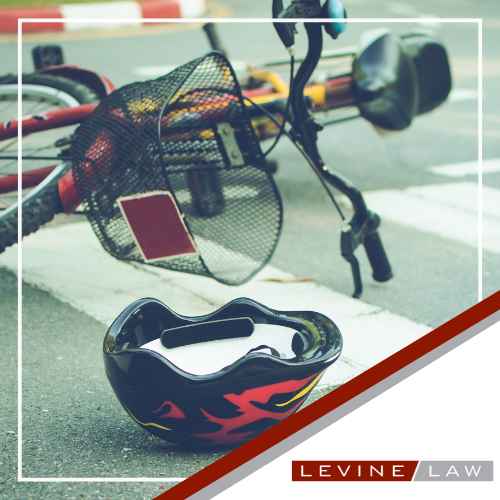
What actually happens after a bike crash in Aurora?
The official record moves slower than the insurance side does. The Aurora Police Department posts crash reports through a third-party site called Crashdocs for a $10 fee, often taking several days to appear — pulling yours requires a last name from the crash plus the date, or the report number itself (Aurora’s follow an AP2026##### or 2026-##### format). The APD Records Section (303-739-6320) sits at 15001 E. Alameda Parkway.
The insurer doesn’t wait on paperwork, though — expect a call within a day or two. Bicycle claims draw a predictable line of questioning: whether you were visible, whether you had a helmet on, whether you belonged on that road at all. Anything you say on that call, before you know the full extent of your own injuries, can end up used against you later. You’re free to share the basics and decline a recorded statement until a lawyer has reviewed the case.
What are the most common causes of bicycle accidents in Aurora?
Most Aurora bike crashes come down to driver mistakes at intersections, driveways, and trail crossings. Statewide, 14 bicyclists were killed on Colorado roads in 2024. A few patterns cause most of the serious injuries:
- Unsafe passing — a driver squeezes by without the clearance Colorado law requires, a frequent problem on wide, fast roads like Chambers Road and Havana Street.
- The “right hook” — a driver overtakes a cyclist, then cuts right across their line of travel, a pattern that shows up often around busy shopping-center entrances.
- The “left cross” — a driver coming the other way turns left directly into a cyclist’s right of way, a recurring problem at signaled intersections along East Colfax Avenue.
- Dooring — a parked driver swings a door open without checking, a violation of C.R.S. § 42-4-1207 that shows up wherever street parking sits next to a painted bike lane.
- Not yielding at trail crossings — a driver rolls through exactly where the Highline Canal Trail, the Sand Creek Regional Greenway, or a Cherry Creek State Park path crosses an Aurora street.
Colorado backs cyclists with rights of their own, which drivers are legally bound to respect — so nailing down the specific sequence of events is often what makes or breaks a claim.


What Colorado bicycle laws affect your case?
Under C.R.S. § 42-4-1412, a cyclist on an Aurora street has the same rights and duties as any driver. Colorado layers a few rider-specific rules on top of that baseline, and these are usually what decide who was at fault:
- The 3-foot passing law — C.R.S. § 42-4-1003 sets three feet as the minimum space a driver must give when passing. A pass that violates it is both a ticketable offense and useful evidence against the driver, particularly on Aurora’s narrower or higher-speed corridors.
- The Safety Stop law — C.R.S. § 42-4-1412.5 lets a rider 15 or older roll through a stop sign like a yield, and treat a red light the way a stop sign works, once it’s safe and they have the right of way. Following that law to the letter directly undercuts the insurer’s go-to argument that the cyclist broke a traffic rule.
- Same protections as a car — Colorado doesn’t carve out a lesser standard for cyclists; a driver who ignores a rider’s right of way has broken the identical rule that would protect a car in the same spot.
Helmets are worth noting too: Colorado imposes no legal requirement that adult riders wear one, so going without is not itself a violation. An insurer may still try to argue a bare head made your injuries worse, which is exactly the kind of argument a lawyer is positioned to push back on.
Lighting is a different story — it’s mandatory, not optional. From sunset to sunrise, and anytime a rider wouldn’t be clearly visible from 1,000 feet away, C.R.S. § 42-4-221 requires a bike to carry a white front headlight visible from 500 feet and a red rear reflector or light visible from 600 feet. Skip that equipment on a dusk ride down East Colfax Avenue, and the insurer gets a visibility argument that’s harder to shake than the helmet one.
What types of injuries are common in Aurora bicycle accidents?
A bicycle offers zero protection against a moving vehicle — an impact a car’s bumper would barely register can leave a rider with catastrophic harm. The severity of that harm typically sets both the length of recovery and what the claim is ultimately worth.
- Road rash and skin injuries — deep abrasions from sliding across pavement that can require skin grafts, leave permanent scarring, and carry a real infection risk if left untreated.
- Traumatic brain injuries (TBI) — ranging from a concussion to permanent cognitive and memory deficits; a helmet reduces the risk but doesn’t eliminate it.
- Spinal cord injuries — with the potential for partial or complete paralysis, depending on where the damage occurs.
- Fractures to the collarbone, wrists, forearms, and legs, typically from the fall that follows the initial impact.
- Internal bleeding — not always obvious in the first hours, which is why prompt evaluation at a Level I trauma center like UCHealth University of Colorado Hospital on the Anschutz Medical Campus matters even if you feel okay.
- Catastrophic injuries — amputation and permanent disability among them, reshaping both medical care and long-term financial planning.
A child on a bike changes the picture further — Children’s Hospital Colorado on the Anschutz campus is the region’s only pediatric Level I trauma center, and a child-injury claim carries its own rules. Because some injuries don’t fully surface for days, prompt follow-up care matters for the case as much as for your health.
Who is liable for a bicycle accident in Aurora?
A bicycle claim rests on negligence — whether a driver exercised reasonable care around someone on two wheels — and fault for an Aurora bike crash often reaches beyond just the driver. It can trace back to:
- A driver who broke one of the rider-specific rules — still the most common source of liability, whether that’s an unsafe pass, a failure to yield, or a careless dooring.
- An employer, under the legal doctrine of respondeat superior (an employer answering for an employee’s actions on the job) — when the driver was on a delivery run, a rideshare pickup, or a work route.
- A manufacturer, if a car defect played a part, or a faulty bike component caused a loss of control.
- A government entity — the City of Aurora, the state, or the Regional Transportation District (RTD) can be on the hook for a flawed road or trail-crossing design, a hazard left unrepaired, or a collision involving a transit vehicle along the I-225 R Line, though these claims run through the Colorado Governmental Immunity Act and its 182-day notice requirement (C.R.S. § 24-10-109).
Colorado’s modified comparative negligence rule then divides fault proportionally: a share of 49% or less trims your award by that percentage, while 50% or more wipes it out entirely — the exact reason insurers lean so hard on arguing the cyclist caused their own crash.

Attorney insight: What makes Aurora bicycle cases complex?
Bicycle claims hinge on fragile physical evidence and rider-specific traffic laws that insurers routinely dispute, which makes fault harder to prove than in an ordinary car crash.
What makes Aurora bicycle claims complex:
- Fault is almost always disputed. Colorado’s modified comparative negligence rule bars any recovery once a rider is 50% or more at fault, so insurers work to pin as much blame on the cyclist as they can.
- Cyclist-specific statutes carry unusual weight here. Because the 3-foot passing law and the Safety Stop law spell out exactly what’s expected of both driver and rider, a cyclist who can show they followed those rules has a ready answer to the insurer’s favorite claim — that the rider caused their own crash.
- Venue depends on the exact crash site. Aurora spans Arapahoe, Adams, and a sliver of Douglas County, so the same city can send a case to the 18th or 17th Judicial District depending on where the crash happened.
- A public road or trail defect adds a hard deadline. If a dangerous road or a trail crossing on the Sand Creek Regional Greenway or Highline Canal Trail played a part, the Colorado Governmental Immunity Act requires written notice within 182 days — miss it and the claim is barred.
- Physical damage to the bike doubles as proof. Where the frame bent, how the helmet cracked — these details can establish the force and angle of the collision, which is exactly why they need to be documented before anyone thinks to fix or discard them.
Trial readiness isn’t an afterthought here — it shapes how the case gets built from day one. That means locking down the bike, the helmet, and any nearby video before they’re gone; bringing in crash-reconstruction and medical experts while the trail is still fresh; building a real record of how the injury has changed the rider’s life; and treating every file as though it could end up in front of a jury — because some of them do.
What damages can you recover after an Aurora bicycle accident?
Colorado injury victims can recover two kinds of damages: economic damages (measurable financial losses) and non-economic damages (human losses like pain and suffering). Non-economic damages are limited by statute (C.R.S. § 13-21-102.5). On the other hand, economic damages have no cap.
Economic damages typically include:
- Current and future medical expenses, from the ER to rehabilitation.
- Lost income and reduced future earning capacity.
- Property damage and other out-of-pocket costs, like your bicycle and gear and a rental, or home and vehicle changes.
Non-economic damages include:
- Emotional distress — the anxiety, fear, and psychological trauma the crash caused.
- Pain and suffering — the physical discomfort and pain from your injuries.
- Scarring and disfigurement — permanent marks from injuries or surgeries.
- Loss of companionship — the strain on your relationships with family.
- Loss of enjoyment of life — being unable to take part in hobbies or daily routines you enjoyed before the crash.
While non-economic damages are personal, they often create real bills. Therapy for trauma and medicine for pain cost money, and permanent scarring can make it hard to work again. In Colorado, you can seek economic damages for those costs, plus non-economic damages for the human toll of the crash.
Legal note on Colorado’s damage caps
Filed on or after January 1, 2025, a bicycle injury claim’s pain-and-suffering damages are capped at $1.5 million under HB 24-1472 — well above the figure it replaced. Nothing caps the economic side: medical bills and lost income get paid in full regardless of size. A driver whose conduct crosses into reckless or extreme territory can also expose them to exemplary damages under C.R.S. § 13-21-102, a category built to punish rather than compensate. What usually moves the needle is documentation — thorough medical and financial records are what separate a lowball offer from the claim’s actual worth.
How long do you have to file a bicycle accident claim in Colorado?
Colorado gives you three years from the date of the crash to file a bicycle accident lawsuit — a car-versus-bicycle collision counts as a motor vehicle claim under C.R.S. § 13-80-101. That’s a full year longer than the deadline on most other injury claims, though it still eventually closes.
A fatal crash shortens things considerably: a wrongful death claim generally has to be filed within two years, stretching to four if the driver left the scene. An injured child’s deadline can run differently too, which makes confirming your specific timeline early worth doing.
Pitfall alert: a road-hazard or trail claim can carry an 182-day deadline
One government-related trigger can shrink that three-year window down to almost nothing. If a poorly maintained road or trail crossing, a City of Aurora vehicle, or an RTD R Line vehicle played any part in the crash, the Colorado Governmental Immunity Act controls instead — and it demands written notice within 182 days of learning about the injury, full stop. Nothing about the three-year deadline applies once this notice requirement is missed. The claim simply ends.
Riders hurt at a crossing like the Highline Canal Trail’s intersection with an Aurora street run into this more than most, since the crossing itself is usually the government-controlled piece of the puzzle.
Why do you need a bicycle accident lawyer in Aurora?
Bicycle claims start out lopsided: the driver walks away with a vehicle, an insurance company backing them, and often the only firsthand account besides yours — while you may still be getting checked out at a hospital. A lawyer exists to close that gap.
- Fault gets contested almost reflexively, and real injuries get quietly minimized — that’s simply how insurers protect their margins.
- A lowball offer often lands before anyone — including you — has a clear picture of how serious a brain or spinal-cord injury actually is.
- Add a flawed road design, a City vehicle, or an RTD vehicle to the mix, and you’re suddenly navigating overlapping public and private insurance plus an 182-day deadline that doesn’t bend.
Opponent playbook
On roads like Havana Street or East Colfax Avenue, the insurer’s go-to move is to say you caused your own crash — that you swerved unpredictably, blew through a light, or rode without a helmet. It’s not a small thing. Under Colorado’s comparative fault rule, every percentage point they pin on you comes straight out of your settlement, and going over 50% wipes it out entirely. That’s why this argument comes up in nearly every bicycle case we handle. The Safety Stop and 3-foot passing laws frequently prove the opposite — that the rider was following the rules and the driver wasn’t. However, nobody hands that evidence over voluntarily. Our response is to move fast, securing the DR 3447 report, the bike and helmet themselves, nearby video, and witness accounts before any of it disappears.
What does the bicycle accident claim process look like?
Most claims follow a clear path: a free talk, an investigation, a demand and back-and-forth, and — if the insurer won’t be fair — a lawsuit in the right Colorado court.
- Free consultation and case review — we look at the crash, your injuries, and available coverage. That includes the driver’s policy and any uninsured/underinsured motorist coverage you carry.
- Investigation and evidence — the DR 3447 report, medical records, the saved bike and helmet, scene evidence, video, and witness statements.
- Demand and negotiation — we send a documented demand and negotiate with the insurer.
- Settlement or lawsuit — if talks stall, we file suit. Most Aurora crashes fall in Arapahoe County, where civil cases are heard in the 18th Judicial District at the Arapahoe County Justice Center, 7325 S. Potomac St., Centennial. A crash in north Aurora may fall in Adams County (17th Judicial District), depending on where it happened.
How long this takes depends on how serious the injuries are and on the court’s schedule.
How do you choose the right Aurora bicycle accident lawyer?
Look for real experience with serious bicycle cases, knowledge of Aurora-area courts and insurers, clear communication, and trial readiness you can verify rather than take on faith.
- Does the firm have relevant experience?
Levine Law has spent more than two decades representing injured people across the Denver metro, and that includes results for cyclists’ peer group of vulnerable road users: a $925,000 settlement after a pedestrian was struck by a red-light runner, and a $770,000 verdict from a truck crash (see the full case results; prior outcomes don’t guarantee a future one). Add the AV Preeminent rating — the top peer-review mark Martindale-Hubbell gives for legal ability and ethics — plus separate recognition from Super Lawyers and the National Trial Lawyers, and the credentials back up the number.
- Do they know Aurora’s courts and cyclist laws?
The 3-foot passing law and the Safety Stop law exist because lawmakers recognized the bias cyclists face on the road — and insurers carry that same bias straight into a claim. Firm founder Jordan S. Levine argued Crowell v. ICAO, a ruling that still governs how Colorado holds insurers accountable, and the firm’s attorneys know how the 18th Judicial District actually operates.
- Are they ready to go to trial?
A bicycle crash changes your life in an instant. We don’t just process paperwork; we build your case from day one with the goal of being ultimately ready for trial. This means we immediately lock down critical evidence like the damaged bike, the helmet, and any nearby video before it disappears. We bring in medical and crash-reconstruction experts early to strengthen your position, and we build a complete record of how your injuries have changed your life. We treat every file as though it will be presented to a jury, because being prepared for the courtroom is the best way to ensure your rights are protected.
- Are the fees clear?
Contingency, no exceptions — no attorney’s fee unless Levine Law recovers for you, and the first conversation is free.
After a bicycle crash, you need a legal team that understands both the challenges cyclists face and how insurers build their defenses. Levine Law combines more than two decades of Colorado personal injury experience with a trial-ready approach, giving you a team that can investigate the crash, preserve critical evidence, and push back when insurers try to shift blame. From your first consultation through resolution, we focus on protecting your rights and pursuing the compensation you deserve.
Client testimonials
Ask Levine Law’s past clients what stood out, and the same theme comes up — being treated like a person, not a case file.
“Had nothing but the utmost respect for Jordan and his whole team! They treated me like family, and I always felt they had my best interest at heart.” — Christina, five-star review.
You can read more verified reviews on our Levine Law Reviews page.
Disclaimer: Client reviews are individual experiences and do not guarantee any particular result.
Case results that reflect real experience
A cyclist struck by a car takes the full force of the crash, and the broken bones, head injuries, and long recoveries look much like those in other serious traffic cases. The results below come from other kinds of cases, but each involved someone who suffered the same injuries — and the same fight with an insurer over fault:
- $925,000 settlement — a driver ran a red light and struck a pedestrian crossing the street, who suffered two broken legs and spent a week in the hospital.
- $1.3 million settlement — a driver ran a red light and hit the client, breaking his leg.
- $770,000 verdict — a truck crash that caused neck, back, and abdominal injuries.
More outcomes are listed on our Cases & Verdicts page.
Disclaimer: Prior results do not guarantee a similar outcome; every case is decided on its own facts.
Areas served
Levine Law represents bicycle accident victims throughout Aurora and the surrounding Front Range. Our Aurora practice connects to the firm’s broader network of practice areas and locations:
- Aurora Personal Injury hub
- Aurora car accidents and Aurora pedestrian accidents
- Denver bicycle accidents (main hub)
- Boulder bicycle accidents
- Lakewood bicycle accidents
- Denver personal injury
We also handle related cases, including dooring accidents, traumatic brain injury, and spinal cord injuries.
Local resources
Level I Trauma Centers (Aurora)
- UCHealth University of Colorado Hospital — 12605 E 16th Ave, Aurora, CO 80045 (adult Level I; state’s only ABA-verified burn center)
- Children’s Hospital Colorado — 13123 E 16th Ave, Aurora, CO 80045 (region’s only pediatric Level I trauma center)
Crash reports & agencies
- Aurora Police Department Records — reports via Crashdocs ($10); Records Section 303-739-6320, 15001 E. Alameda Parkway.
- Colorado DMV — Report a Crash
- IIHS — Colorado fatality statistics (2024)
Courts
- Arapahoe County District Court (18th Judicial District) — Arapahoe County Justice Center, 7325 S. Potomac St., Centennial, CO 80112
- Adams County District Court (17th Judicial District) — Adams County Justice Center, 1100 Judicial Center Dr., Brighton, CO 80601
Disclaimer: We provide these resources for convenience only; we do not endorse or profit from them.
Frequently asked questions
How long do I have to file a bicycle accident claim in Aurora?
You usually have three years from the crash date, because a car-versus-bicycle crash is a motor vehicle claim under C.R.S. § 13-80-101. But if a bad road design or a City of Aurora vehicle was involved, you must give written notice within 182 days under the Governmental Immunity Act. So your real deadline can be much shorter.
What is Colorado’s 3-foot passing law?
Under C.R.S. § 42-4-1003, a driver must leave at least three feet of space when passing a cyclist. Breaking this rule is a ticketable offense and strong proof of a careless driver, especially on wide, fast roads like Chambers Road and Havana Street where drivers often crowd riders.
Can I recover if I wasn’t wearing a helmet in Aurora?
Yes. Colorado does not require adult cyclists to wear helmets, so riding without one is legal. Under the blame-splitting rule (C.R.S. § 13-21-111), you can still recover if you are 49% or less at fault, though insurers may argue a missing helmet made your injuries worse.
What is a dooring accident and who is at fault?
Dooring happens when someone opens a car door into the path of a passing cyclist. The person who opened the door is usually at fault for not checking for traffic. These crashes are common next to street parking and painted bike lanes in Aurora. See our dooring accidents page for more.
Does the Safety Stop law help my case?
It can. Under C.R.S. § 42-4-1412.5, riders 15 and older may treat a stop sign as a yield sign and a red light as a stop sign when it is safe. If you rode legally under this law, it can beat an insurer’s claim that you ran a sign at an intersection along East Colfax Avenue or elsewhere in Aurora.
Contact an Aurora bicycle accident lawyer today.
If you or a family member was injured in an Aurora bicycle crash, Levine Law is available 24/7 to review your claim and explain your options at no cost.
Contact us online for a free, no-obligation consultation.
Attorney Review Disclosure
This content has been reviewed by the attorneys at Levine Law to help ensure its accuracy and compliance with applicable Colorado law. Legal services are provided by attorneys licensed to practice in the State of Colorado.
Denver Office
Levine Law LLC
4500 Cherry Creek S Dr #400
Denver, CO 80246
24/7 Hotline: (303) 333-8000
Other Cases We Take On
Beyond bicycle crashes, Levine Law helps injured Coloradans across many practice areas:
- Car Accidents
- Truck Accidents
- Motorcycle Accidents
- Pedestrian Accidents
- Dooring Accidents
- Premises Liability
- Traumatic Brain Injuries
- Spinal Cord Injuries
- Catastrophic Injury
- Wrongful Death
This content is for informational purposes only and does not constitute legal advice. Reading it does not create an attorney-client relationship. Past results do not guarantee future outcomes; every case is evaluated on its own facts. This content has been prepared for review by Colorado-licensed attorneys at Levine Law.


